
Soil Testing & Civil Material Testing in Bengaluru | NABL Lab – Edge2
Get reliable soil testing and civil material testing in Bengaluru with a NABL-accredited lab. SPT, SBC, CBR, field density, concrete, cement, steel, aggregates—avoid rework & build safely.
Why Soil Testing Before Construction Is Non-Negotiable
Whether you are building a house (G+1/G+2), an apartment, a commercial building, a warehouse, or an industrial shed, your structure is only as strong as the ground it stands on. In many Bengaluru locations, soil conditions vary drastically—filled-up soil, soft clay pockets, loose sand layers, weathered rock, and fluctuating groundwater levels are common.
That’s why soil testing before construction is not just “recommended”—it is the smartest way to:
Prevent uneven settlement, tilting, and foundation cracks
Avoid overdesign (wasting concrete and steel)
Reduce repair/rework cost after construction
Get correct foundation type and depth based on actual soil strata
Support approvals and documentation with a professional soil investigation report
If you want long-term safety and peace of mind, your first step should always be a soil test (geotechnical investigation).
What You Get in a Good Soil Testing Report?
A strong soil test report should not be “numbers only.” It should help your engineer make decisions.
A practical soil testing report typically includes:
Soil strata / soil profile (layer-by-layer soil type and properties)
SPT N-values (soil resistance and strength with depth)
SBC (Safe Bearing Capacity) recommendations
Foundation recommendations (isolated footing / combined footing / raft / piles—based on data)
Settlement considerations and risk notes
Groundwater observation (important for excavation and dewatering planning)
Construction precautions (backfill compaction, dewatering, soil improvement if needed)
Edge2 provides soil investigation supported by a NABL-accredited laboratory and standard procedures—so your results are reliable and usable for real engineering decisions.
Soil Testing Process in Simple Steps
Here’s the typical process:
Site visit + test location finalization (based on plot size and building type)
Borehole drilling / trial pits (as required)
SPT test at different depths + field observations
Soil sampling (disturbed and/or undisturbed)
Laboratory testing (NABL-accredited lab testing for key parameters)
Engineering interpretation + report with foundation recommendations
This is the professional way to do soil testing—quick, systematic, and accurate.
Key Soil Tests That Help You Decide Foundation
1) SPT Test (Standard Penetration Test)
The SPT test gives N-values, which indicate soil density/strength at different depths. These values influence:
foundation depth
bearing capacity estimation
settlement risk
need for raft or piles (if soil is weak)
2) Atterberg Limits (Liquid Limit, Plastic Limit)
Essential for clayey soils. Helps understand:
swelling/shrinkage behavior
plasticity
long-term stability risks
3) Sieve Analysis / Grain Size Distribution
Tells whether soil is mostly sand, silt, or clay and affects:
drainage behavior
compaction behavior
foundation approach and soil improvement decisions
4) Moisture Content, Density, Specific Gravity
Useful for understanding natural condition and compaction control.
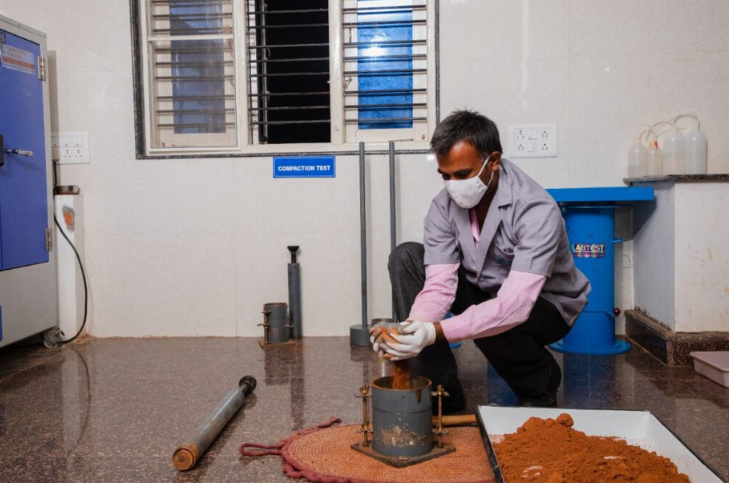
5) Proctor Compaction Test
Very important for backfilling, plinth filling, and road subgrade.
6) CBR Test (California Bearing Ratio)
Highly used for roads, driveways, parking areas—important for pavement thickness design.
7) Plate Load Test (When Required)
Directly measures bearing behavior for certain sites and conditions.
When these tests are done and interpreted correctly, your foundation design becomes safer and more economical.
The Second Part That Most People Ignore: Civil Material Testing (Construction Material Testing)
Even if your soil is perfect, your structure can still fail if materials are inconsistent.
That’s why serious builders and consultants also do civil material testing (construction material testing) for:
concrete quality
aggregates
cement
steel
bricks/blocks/pavers
durability tests (when required)
At Edge2, soil investigation and material testing work together—so your project quality is verified from the ground up.
Construction Material Testing Checklist:
A) Concrete Testing
Concrete cube compressive strength (7-day & 28-day)
Workability checks (site slump test guidance)
Durability tests (as required): RCPT / permeability
✅ Helps avoid low strength, honeycombing issues, and disputes at site.
B) Aggregate Testing (Sand & Coarse Aggregate)
Sieve analysis / gradation
Specific gravity & water absorption
Mechanical properties (as applicable): crushing/impact values
✅ Aggregates strongly influence concrete strength and durability.
C) Cement Testing (Quality Verification)
Fineness
Initial & final setting time
Soundness
Strength verification (as applicable)
✅ Prevents unexpected setting problems and low strength concrete.
D) Steel Testing for TMT Bars (Fe500 / Fe550 / Fe600)
Yield strength
Tensile strength
Elongation
Bend / re-bend tests
✅ Confirms grade and ductility—critical for RCC safety.
E) Brick / Block / Paver Testing
Compressive strength
Water absorption
dimensional checks (as applicable)
✅ Ensures uniform quality and reduces plaster cracks and failures.
Why NABL-Accredited Lab Matters?
A NABL-accredited laboratory typically means:
controlled standard procedures
calibration discipline
traceable documentation
quality checks for testing accuracy
For clients, it means fewer disputes and more confidence in reports.
At Edge2, your soil and material tests are supported by a NABL-accredited laboratory workflow, which helps deliver dependable results for design and construction decisions.
Soil Testing Cost in Bengaluru: What Affects Pricing?
Soil testing cost depends on:
plot size and type of building (residential vs commercial)
number of boreholes required
depth of investigation needed
soil strata complexity
testing scope: basic vs detailed (SPT + lab + reporting)
travel/logistics (site location within Bengaluru/Karnataka)
Important: The “cheapest soil test” often becomes the most expensive later due to inaccurate data. A correct soil report saves huge foundation costs.
When Should You Do Soil Testing?
Do soil testing before finalizing foundation drawings and ideally before excavation.
Best timing:
after final plot boundaries are fixed
before structural design is started
when your architect/engineer is ready to lock building plan
Who Needs Soil Testing + Material Testing
This section attracts high-quality leads:
Individual home owners building new house
Builders and developers
Architects and structural consultants
Contractors and PMC teams
Industrial shed / warehouse owners
Government and infrastructure contractors
Renovation projects needing structural assessment
If you’re in any of these categories, soil + material testing is the most practical quality control investment.
Why Choose Edge2 for Soil Testing & Civil Material Testing?
When clients contact you, they want confidence. Keep it simple and strong:
✅ Soil testing (geotechnical investigation) with SPT and lab support
✅ NABL-accredited laboratory-backed testing
✅ Standard methods aligned with relevant IS codes
✅ Clear reporting with practical foundation recommendations
✅ Civil material testing support for concrete, cement, steel, aggregates, bricks/blocks/pavers
✅ Suitable for residential, commercial, industrial, and infrastructure projects
Quick FAQs:
1) Is soil testing required for a house construction?
Yes. Soil conditions vary even within short distances. Soil testing helps decide foundation type and prevents settlement and cracks.
2) What is SBC in soil testing?
SBC means Safe Bearing Capacity—the load the soil can safely carry without failure or excessive settlement.
3) How many boreholes are needed?
It depends on plot size, building type, and load. A professional site assessment decides this.
4) How long does soil testing take?
Typically a few days for field work + lab testing + report preparation, depending on scope.
5) Why should I test cement and steel also?
Because material inconsistency causes low concrete strength and structural safety risks. Testing avoids rework and disputes.
If you are planning construction in Bengaluru or Karnataka, don’t guess your foundation.
Get Soil Testing + Civil Material Testing from Edge2
Soil Investigation (SPT + lab tests + SBC + foundation recommendation)
NABL-accredited laboratory supported testing
Concrete, cement, steel, aggregate, and masonry material verification
Call / WhatsApp Edge2 to schedule a site visit and testing plan.
EDGE2 Engineering Solutions India Pvt. Ltd.
Quick Links
Phone
+919448377127
+919880973810
080-50056086
© 2025. All rights reserved.


Connect with us
Working Hours:
Monday to Saturday 9:00 - 18:00
Address:
Shivaganga Arcade, B35/130, 6th Cross, 6th Block, Vishweshwaraiah Layout, Ullal Upanagar, Bangalore- 560056
Home About Certificate Services Blogs Contact