
Geotechnical Investigation
Geotechnical Investigation Services
Field investigations are carried out using advanced boring techniques such as Auger Boring and Rotary / Hydraulic Drilling to accurately assess subsurface conditions. At our accredited laboratory in Bangalore, we conduct comprehensive geotechnical investigations on soil and rock samples to precisely determine their physical and mechanical properties. These properties are critical for construction, geotechnical engineering, infrastructure development, and environmental projects. Our systematic testing approach ensures structural safety, durability, and optimized foundation design, reducing construction risks and costs.
The following tests, techniques, and engineering solutions together form a complete geotechnical investigation framework, ensuring the safety, stability, and long-term performance of construction projects.
Field Tests
Our field testing services are performed by experienced engineers using calibrated equipment to assess in-situ soil behavior:
Standard Penetration Test (SPT) – Calyx / Power Winch / Hydraulic (Automatic SPT): Determines soil resistance and subsurface stratification.
Plate Load Test: Evaluates soil bearing capacity for foundation design.
Field CBR Test: Assesses load-bearing capacity of soil in field conditions.
Pile Load Test: Determines axial load capacity of piles through static and dynamic testing.
Sand Replacement Test: Measures in-situ density of soil.
Core Cutter Method: Determines in-situ density and degree of compaction.
Pull-Out Test: Evaluates bond strength between soil and anchors or piles.
Electrical Resistivity Test: Identifies subsurface conditions and soil resistivity variations.
Pile Integrity Test: Assesses the structural integrity of piles.
Field Permeability Test: Measures permeability of soil under natural conditions.
Cross Hole Seismic Test: Determines seismic wave velocity and soil stiffness.
Seismic Refraction Test: Evaluates subsurface layering using seismic waves.
Laboratory Tests
All laboratory tests are conducted in our accredited facility as per IS and ASTM standards:
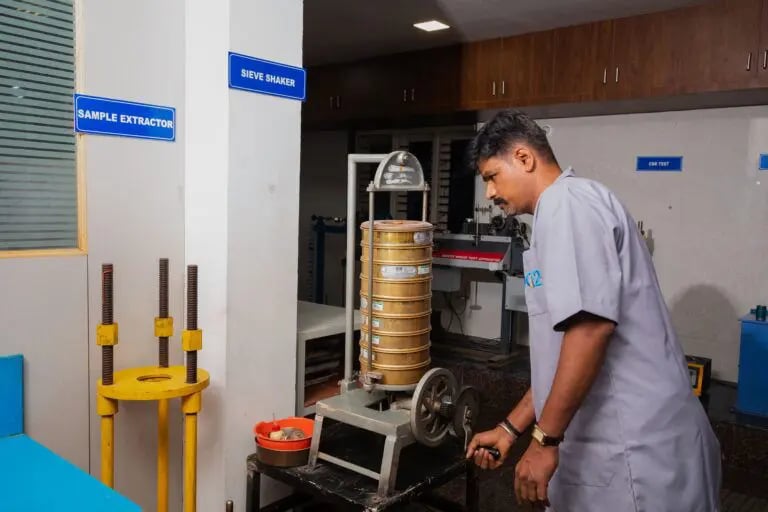
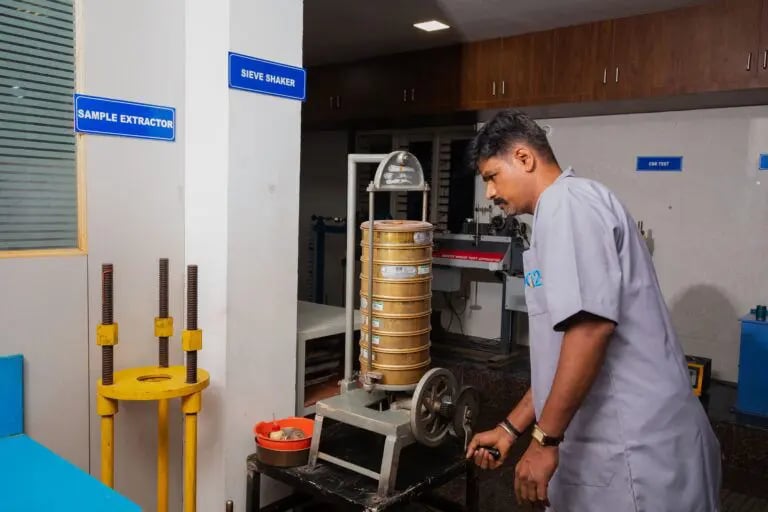
Grain Size Analysis: Determines particle size distribution of soil.
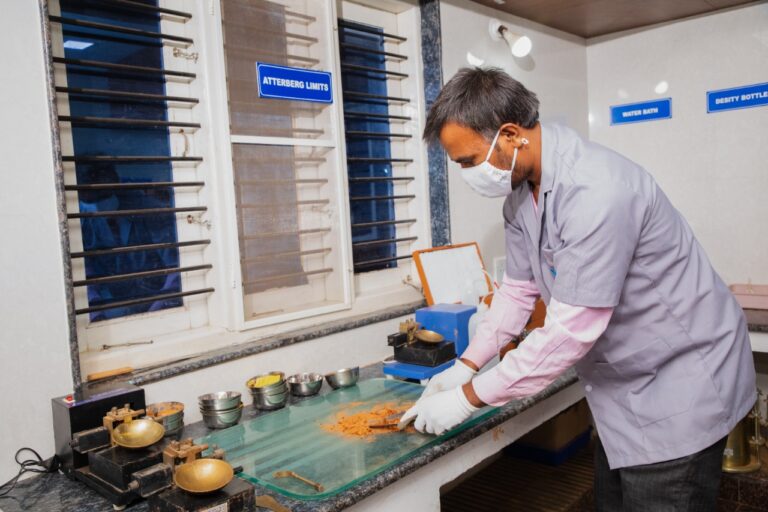
Liquid Limit & Plastic Limit: Evaluates plasticity characteristics of soil.
Shrinkage Limit: Identifies moisture content at which soil begins to shrink.
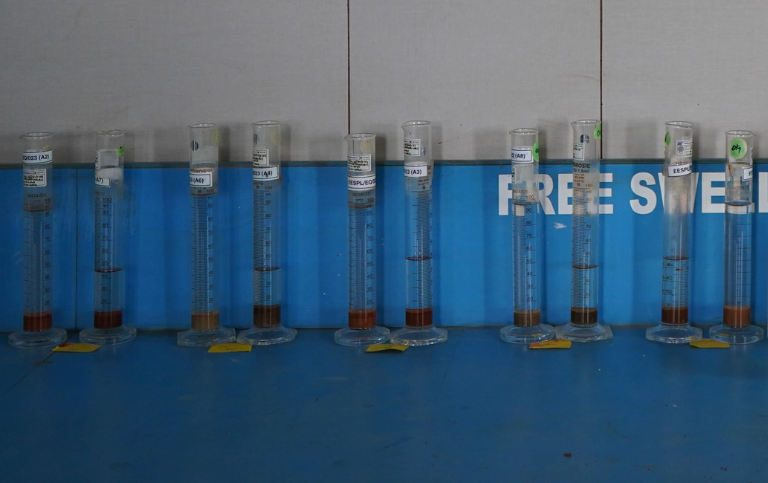
Free Swell Index: Assesses swelling potential of expansive soils.
Specific Gravity: Determines density of soil particles.
Water Content Test: Measures natural moisture content of soil samples.
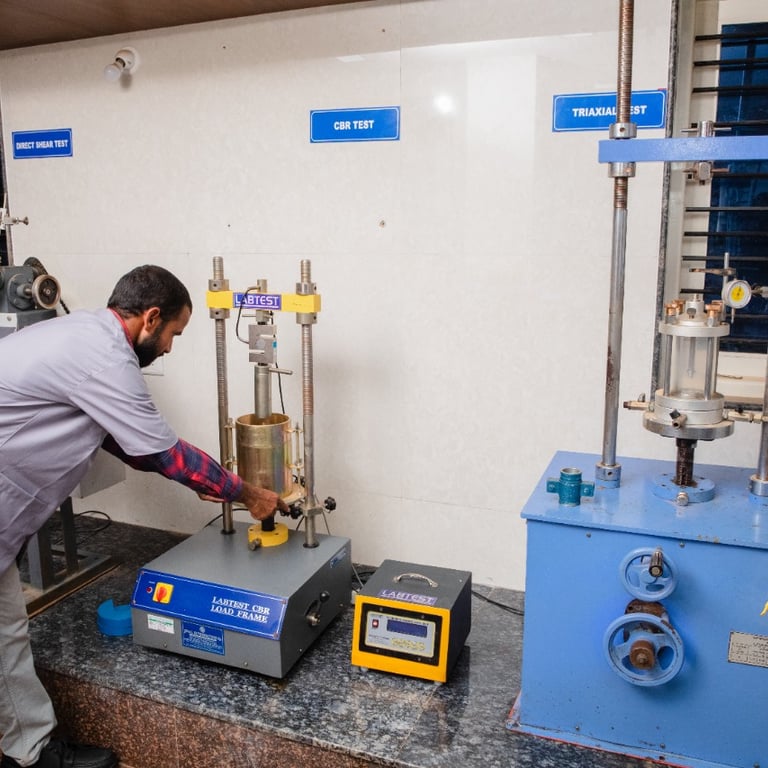
California Bearing Ratio (CBR): Evaluates subgrade strength for pavement design.
Point Load Index Test: Determines strength of rock and rock-like materials.
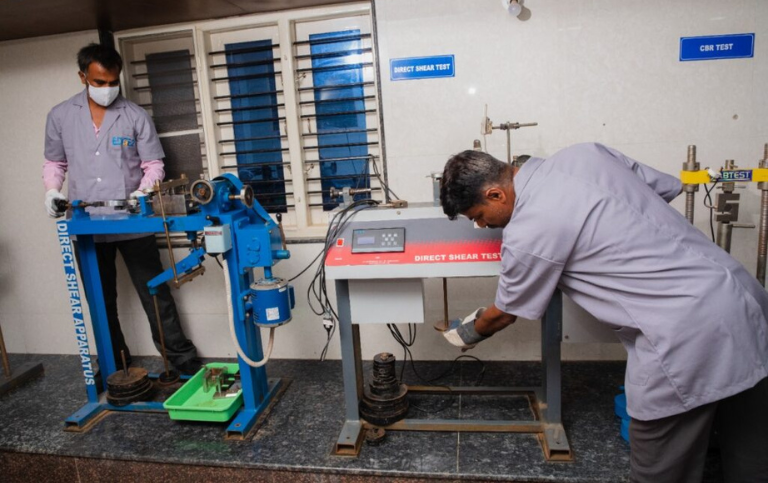
Direct Shear Test: Measures shear strength parameters of soil.
Light Compaction Test: Determines compaction characteristics under light energy.
Heavy Compaction Test: Determines maximum dry density using heavy compaction energy.
UCS on Rock Cores: Determines unconfined compressive strength of rock.
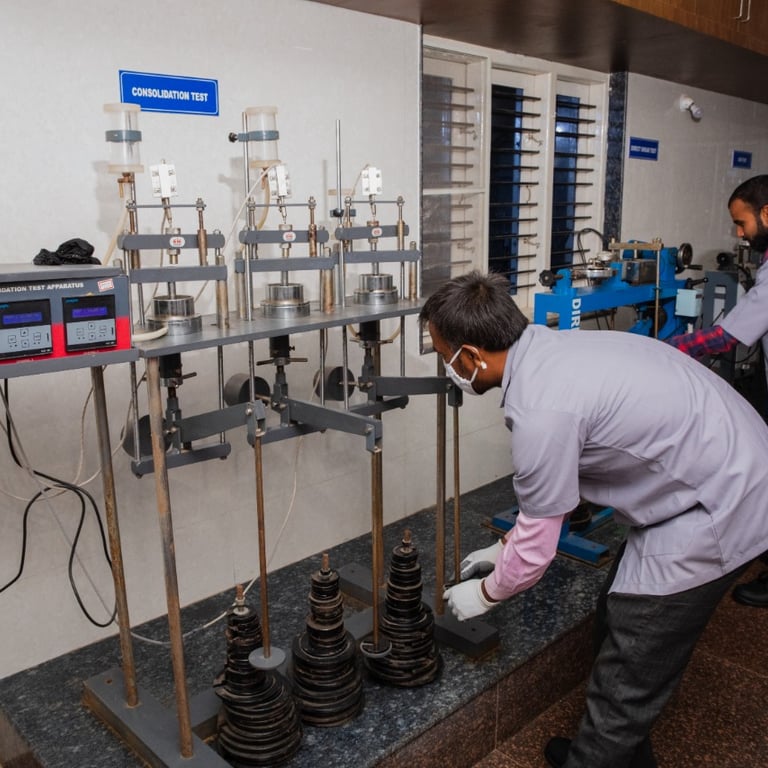
Consolidation Test: Assesses soil settlement and compressibility behavior.
Triaxial Test (UU): Determines shear strength under undrained conditions.
Permeability Test: Measures soil’s ability to transmit water.
Porosity Test on Rock: Determines pore space in rock samples.
Piling Services
Piling techniques are used to transfer structural loads to deeper and more stable soil or rock strata. We provide expert piling solutions for residential, commercial, and infrastructure projects using materials such as concrete and steel.
Our Piling Techniques Include:
Bored Cast In-Situ Piles
Micropiles
Contiguous Piles
Driven Piles
Ground Improvement Techniques
Ground improvement methods are used where natural soil conditions are unsuitable for construction. These techniques enhance soil strength, reduce settlement, and improve stability.
Ground Improvement Solutions:
Shotcreting
Soil Nailing
Ground Anchors
Dewatering Systems
Rainwater Harvesting
Rock Bolting
Grouting
Earth Retention Structures
Earth retention systems are designed to stabilize soil and rock masses, prevent slope failures, and support excavations.
Earth Retention Systems We Design:
Anchored Sheet Piles
Retaining Walls
Liquefaction Analysis
Liquefaction analysis evaluates the susceptibility of soil to strength loss during seismic events. This analysis is essential for earthquake-resistant foundation design and risk mitigation in seismic zones.
Slope Stability Analysis
Slope stability analysis assesses the safety of natural and man-made slopes, embankments, excavations, and earth structures. It helps identify potential failure mechanisms and provides corrective measures to prevent landslides and structural damage.
EDGE2 Engineering Solutions India Pvt. Ltd.
Quick Links
Phone
+919448377127
+919880973810
080-50056086
© 2025. All rights reserved. This website is still under construction.


Connect with us
Working Hours:
Monday to Saturday 9:00 AM - 6:00 PM
Address: